Stop 9 · Gossip Walk
Bridge of Sighs
Széchenyi tér · City Hall
Szeged got its own Bridge of Sighs because of a king's sleeping arrangements.
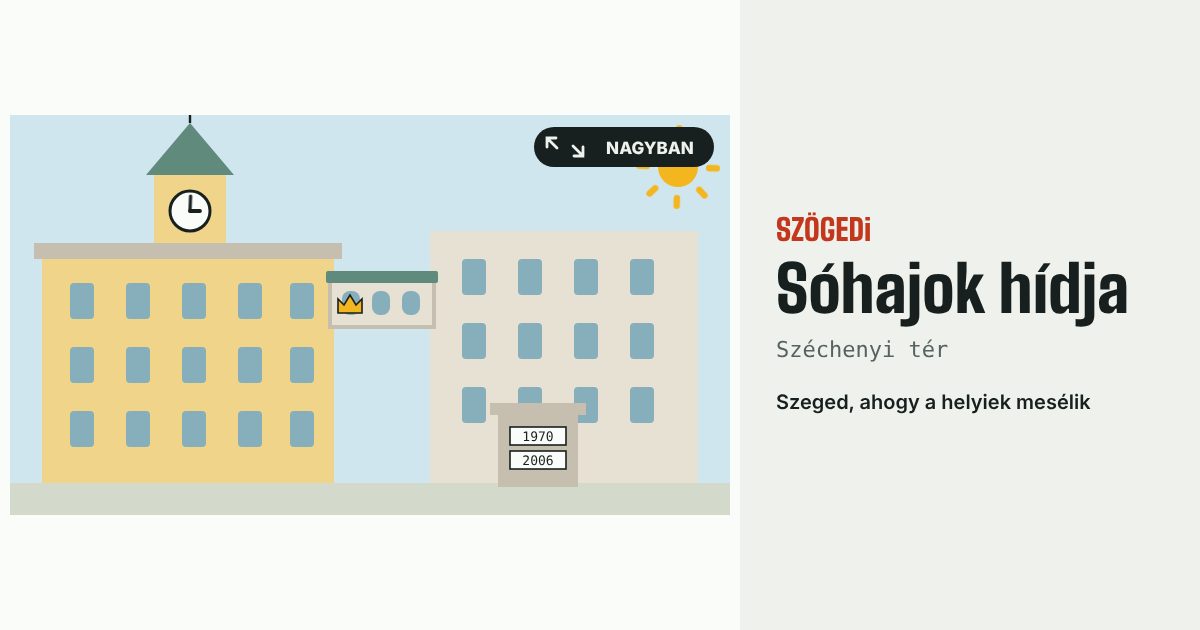
A closed, ornate little bridge spans the gap between City Hall and the neighbouring apartment palace (often simply called the Bérház). This is Szeged's Bridge of Sighs. Nobody planned the name; locals gave it after the bridge in Venice.
In 1883, at the royal days celebrating the rebuilding after the great flood, Franz Joseph came to Szeged. He stayed in the neighbouring apartment palace, while receptions were held in the new City Hall. So that he would not have to cross the street, the two buildings were joined by a covered bridge.
City Hall was rebuilt at that time to designs by Ödön Lechner and Gyula Pártos. Franz Joseph is credited with the saying every local knows: “Szeged will be more beautiful than it was.”
On the river side of the square stands the statue of Pál Vásárhelyi, the engineer of the Tisza regulation. Marble plaques on its pedestal show how high the water rose in 1970 and 2006.
Open in the app →Animated scene, old photos, stamps and the full map. Free, nothing to install.Facts and labels
- TrueThe Bridge of Sighs was built for the 1883 royal days, together with the rebuilding of City Hall (designs by Ödön Lechner and Gyula Pártos).
- True“Bridge of Sighs” is not an official name: locals named it after the bridge in Venice.
- Allegedly“Szeged will be more beautiful than it was.” Attributed to Franz Joseph, but nobody has found the original source yet.
- TrueSzéchenyi tér is over 50,000 m². The western wall of the 13th-century castle ran here; the square was a military drill ground and market. The castle walls were pulled down after the 1879 flood.
- TrueThe white marble statue of István Széchenyi is the work of Alajos Stróbl.
People say
Many people think the Hotel Tisza was named after the river. They also say that Bartók Béla played the piano in its ballroom several times, and that Babits Mihály and Juhász Gyula were regulars at its café.
What we know: According to Szegedma, the hotel was named after Prime Minister Tisza Kálmán. Sources differ on the number of Bartók's performances, mentioning six or seven.
Where it was said: Szeged legendás szállodája a nagy árvíz után született meg (Szegedma) · Széchenyi tér és környéke (irodalmiradio.hu szegedi irodalmi séta)
The people of Szeged called the magnolias that once stood in front of the City Hall “the Lord Lieutenant's tulip trees”. It was said that Lord Lieutenant Kállay Albert loved them so much that he even recorded when they bloomed, and Móra Ferenc wrote that the flowers froze for the first time when their patron resigned.
What we know: The trees were actually magnolias, not tulip trees, and in 1934 they had to be moved because of a planned water basin.
Where it was said: A főispán tulipánfái: a Széchenyi téri magnóliák története (Délmagyar)