Bonus trip · Gossip Walk
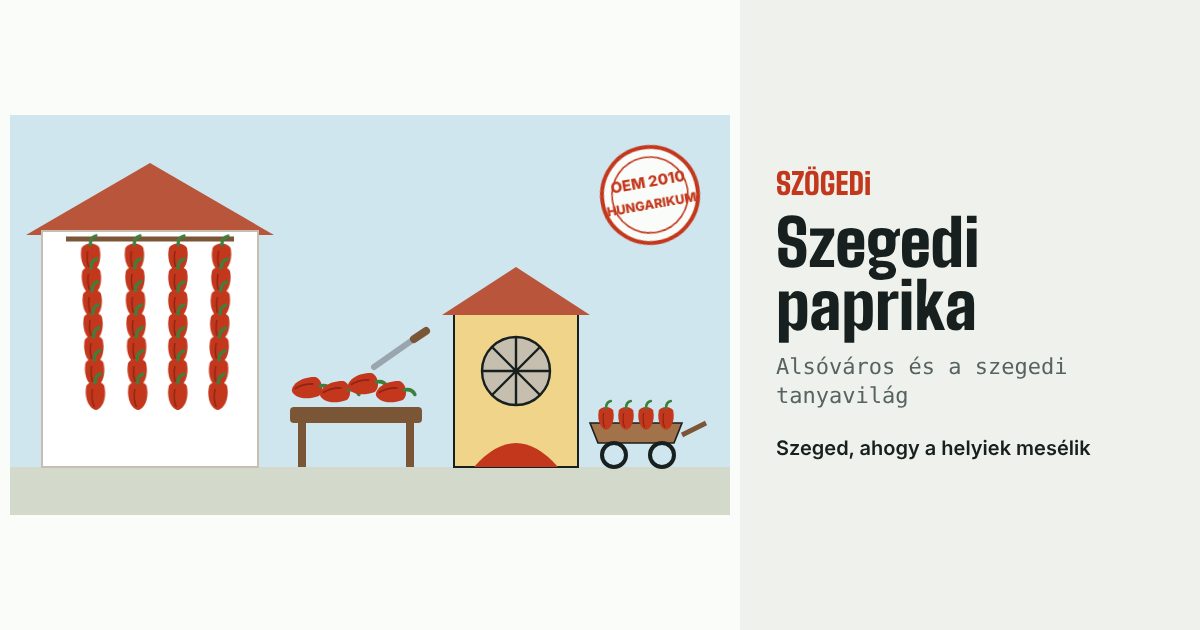
Szeged Paprika
Alsóváros and the Szeged farmlands · a Hungarikum
Tradition says the Franciscans of Alsóváros started growing it. Between the two world wars more than ten thousand people split the pods by hand.
Paprika reached the Carpathian Basin in the 16th–17th centuries, probably with Turkish merchants from the Balkans. Around Szeged it was first grown in the early 19th century, probably by the Franciscans of Alsóváros.
At first it was used to season meat and was thought to aid digestion and help against fever and rheumatism. By the end of the 19th century it was Szeged's most important trade product, whole, crushed and ground.
To make it sweet as well, the hot parts had to be removed by hand: cut off the stem, split the pod, scrape out the veins. Between the two world wars more than ten thousand people did this paprika splitting, and twenty paprika mills worked in the area.
In 1934 the Szeged and Kalocsa paprika regions were officially marked out, and growing and processing required a licence.
Albert Szent-Györgyi bought paprika from Alsóváros by the cartload once he realised it was full of vitamin C. That work became one thread of his 1937 Nobel Prize.
On 3 November 2010 Szeged paprika and Szeged ground paprika received EU protected designation of origin, and in 2015 it became a Hungarikum. You can taste it at the Pick museum on the Felső Tisza-part.
Open in the app →Animated scene, old photos, stamps and the full map. Free, nothing to install.Facts and labels
- Allegedly“The Franciscans started it”: even the Hungarikum description only calls it probable.
- TrueBetween the wars more than ten thousand people split paprika, and twenty paprika mills operated.
- True1934: the Szeged and Kalocsa paprika regions are marked out.
- True2010: EU protected designation of origin. 2015: Hungarikum.
People say
It has long been believed that King Mátyás had the Alsóváros church built, which is why a copy of the Mátyás statue in Bautzen was placed on its wall in 1931. And according to an old tradition, in 1475 Mátyás gave his cloak here to a poor priest saying Mass, which is how the square got its name.
What we know: According to Szegeder, this is “false historical romanticism”, which Bálint Sándor also criticized; Szeged folyóirat calls this explanation of the Mátyás name a misconception.
Where it was said: Történelmi hazugságra húztak volna szoborparkot Szegeden (Szegeder) · Máté Zsolt: Szeged, Alsóvárosi templom tér, Mátyás király tér (Szeged folyóirat)
According to a story told by a grandmother from Alsóváros, the church's Black Madonna painting was hidden in the lake to keep it from the Turks, and was only found much later.
What we know: According to the author of the article, the story is actually linked to the painting on the main altar.
Where it was said: Máté Zsolt: Szeged, Alsóvárosi templom tér, Mátyás király tér (Szeged folyóirat)
Legend has it that Szent-Györgyi Albert did not like paprika, but his wife still packed him paprika sandwiches because she thought it was healthy. Supposedly he started studying it in the lab to prove that his wife was wrong.
What we know: It is a fact that in the Szeged experiments, vitamin C was extracted from paprika.
Where it was said: Seven interesting facts about Albert Szent-Györgyi (Daily News Hungary) · Albert Szent-Györgyi (Wikipedia)