Stop 6 · Buildings Walk
Gróf Palace
Tisza Lajos körút 20 · 1913 · Ferenc J. Raichle
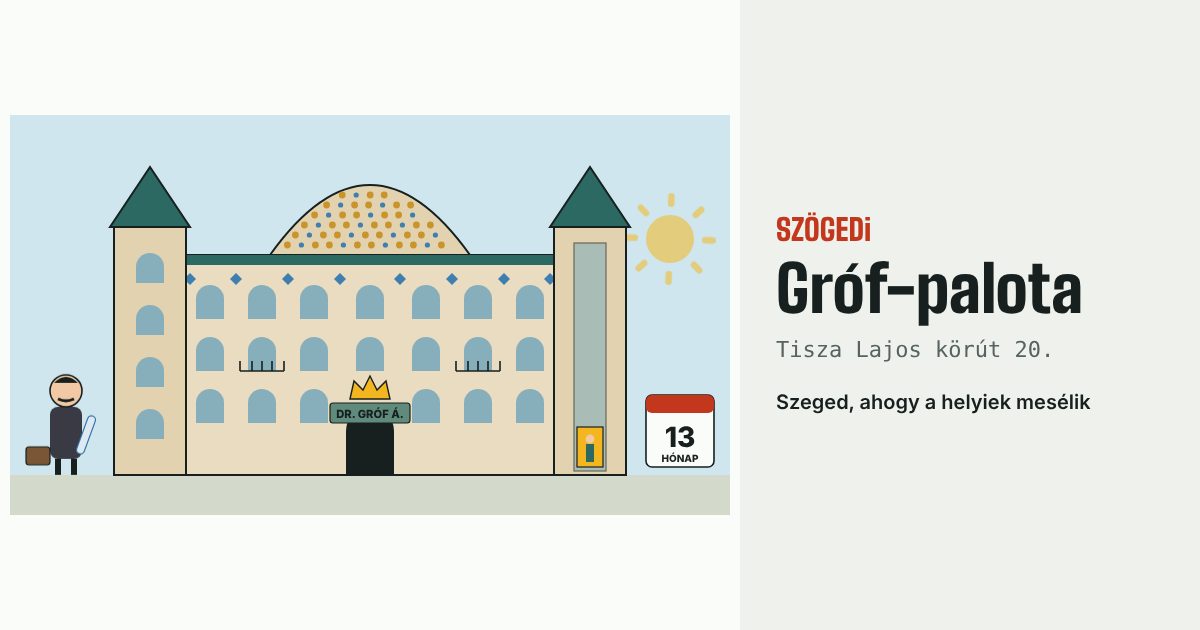
It never belonged to a count (gróf), but to a prosecutor whose surname was Gróf. The gold mosaic on its gables lights up on early summer mornings.
The name is misleading: no count built it. “Gróf” means count in Hungarian, but here it's the owner's surname. Prosecutor Árpád Márton Gróf started the project, according to Wikipedia so that well-paid city officials could live in it. Lawyers' offices were downstairs, flats upstairs.
Ferenc J. Raichle designed it. In Subotica (Szabadka) he had been one of the leading Art Nouveau architects, until a lavish lifestyle, card debts and a political shift ruined him, and in 1906 he had to leave the town. He started over in Szeged and built a whole row of palaces in a few years. This one was the finale of his Szeged period.
It stands on a triangular plot facing three streets, with two corner towers. Blue, yellow and gold decoration with an Eastern feel, ceramic ornaments borrowed from Hungarian folk art, wrought-iron railings. On early summer mornings the sun reflects off the gold patterns on the gables.
It was a modern house: the flats came with a built-in lift and bathrooms. It was finished just 13 months after building began.
It's the largest stand-alone Art Nouveau building in the city centre, and it has survived almost unchanged. It became a listed monument in 2006. By the early 2010s plaster was falling off and the roof leaked; in 2013 the roof was renovated from a joint EU bid by Szeged, Subotica and Senta.
Open in the app →Animated scene, old photos, stamps and the full map. Free, nothing to install.Facts and labels
- True1912–1913, designed by Ferenc J. Raichle, built in 13 months.
- Urban legend“It belonged to a count.” No: Gróf was the owner's surname. Prosecutor Dr Árpád Márton Gróf built it.
- TrueThe largest stand-alone Art Nouveau building in the city centre, listed since 2006.