Bonus trip · Buildings Walk
Water Tower
Szent István tér · 1904 · Szilárd Zielinski
There was a month for the design, 14 entries came in, and only Zielinski solved it. Then one February night the foundation pit went under water.
In April 1903 the city called for designs for a 1,000-cubic-metre water tower, with barely a month's deadline. Fourteen firms and builders entered, from Győr to Timișoara, but only Szilárd Zielinski, a professor at the Technical University, solved the whole task, with the structural engineer Zsigmond Jemnitz.
Zielinski had discovered the French Hennebique reinforced-concrete system at the 1900 Paris World's Fair and bought the Hungarian rights. At first French steel fixers and formwork carpenters worked for him, and Szeged's carpenters learned the trade from them.
An appeal by a losing bidder held things up for months. In December the city issued the permit within three days, but by then winter had set in. On 11 February 1904 a night of rain flooded Szent István tér 50 cm deep: 900 cubic metres of water and mud filled the foundation pit and ruined the steel and the formwork. The contractor had to bear the damage.
Instead of 15 September it was finished at the end of November; it was first filled on 26 November 1904. With its flagpole it is 54.9 metres tall, and everything in it is reinforced concrete, even the front door and the flagpole. The Art Nouveau facade is by Flóris Korb and Kálmán Giergl.
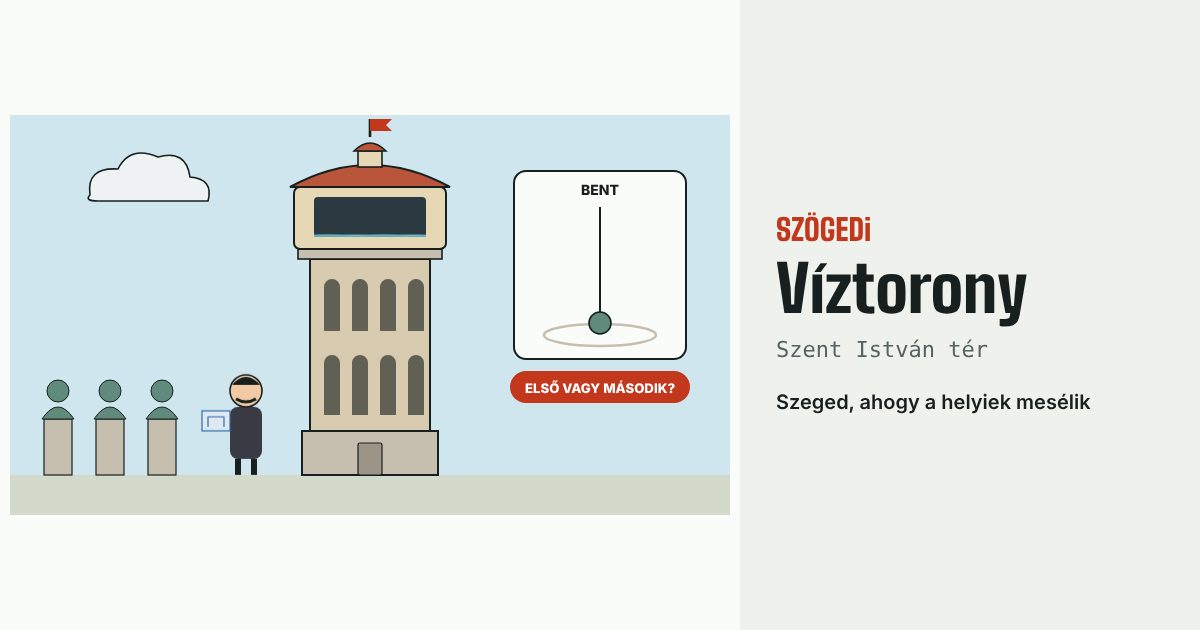
It still works today. It has been a listed monument since 2003 and was renovated in 2005–2006. Around it stand the busts of the Engineers' Pantheon; inside there's an exhibition and a Foucault pendulum. It's open from May to September on the first Saturday of each month, 10 a.m. to 4 p.m.
Open in the app →Animated scene, old photos, stamps and the full map. Free, nothing to install.Facts and labels
- True1904, Szilárd Zielinski, about 1,000 cubic metres of water.
- Half true“The country's first reinforced-concrete water tower.” The city's tourism site says so. According to Wikipedia it was the second: the Kőbánya tower was already being built, also to plans from Zielinski's office.
- TrueIn February 1904 a night of rain flooded the foundation pit.