Bonus trip · Buildings Walk
Olajos ház
Égő Arany house · Oskola utca 4 · 1972 · nine storeys · “the Oil House”
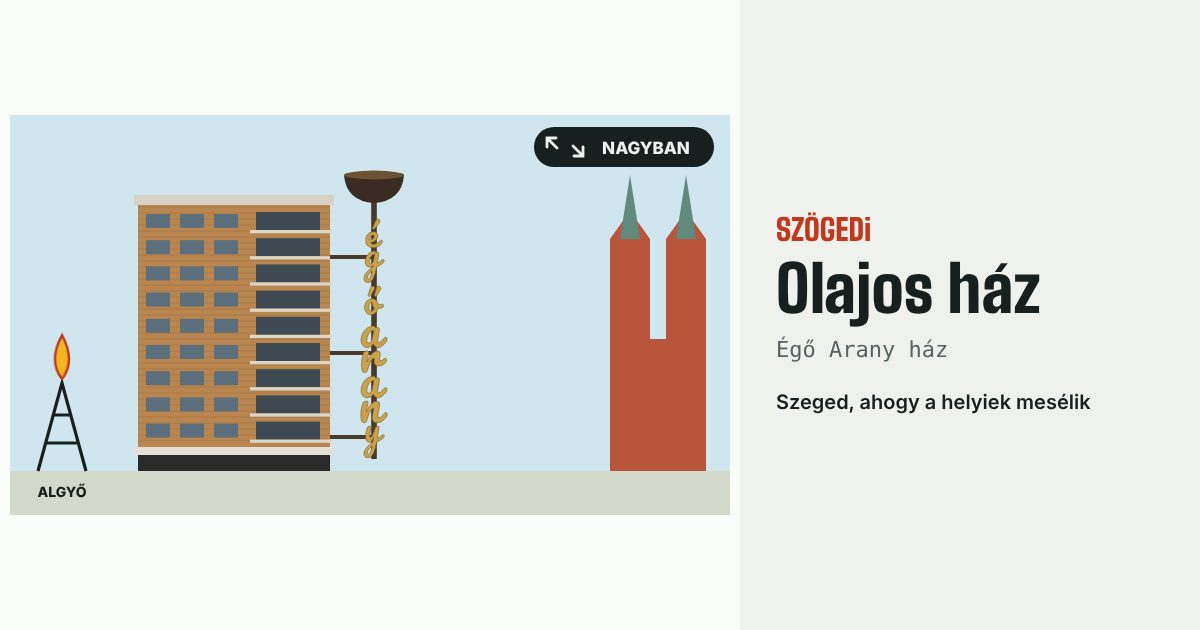
Nine storeys of clinker brick on the corner of Roosevelt tér, with a flaming bowl and a neon sign on its side: Égő Arany, “Burning Gold”. Legend says it was built to hide the cathedral. It was the other way round.
In the 1960s an oil and gas field was found at Algyő, and the oilmen came to Szeged. The official line was that they needed modern flats, immediately.
In 1969 the city council had the old houses at the end of Oskola utca pulled down: the neoclassical Vedres house, with the Fülöp fish tavern on its ground floor, and the Török house.
In their place Ybl Prize-winning architect Béla Borvendég designed a tower block, finished in 1972. According to Délmagyar, Szeged's oilmen originally wanted 20 storeys. It's thanks to the architect that it ended up with nine and doesn't block the view of the cathedral. Even the clinker brick cladding nods to the cathedral's brick.
The Égő Arany café and restaurant opened on the ground floor, named after the flames of the Algyő oil wells. A neon sign with real craftsmanship went on the corner of the building: a pole with the letters stacked one under the other and a flaming bowl on top.
After 1989 it went into private hands and for a while ran as the Vendéglő a Régi Hídhoz (“Old Bridge Inn”). Meanwhile the neon survived when many other neon signs in the area disappeared, and it gave the building its name: locals still call it the Égő Arany house.
In 2024 the city had it restored for about 31.7 million forints: new neon letters, rust protection, bird protection. Since 4 June 2024 a dusk switch turns it on every evening. In September 2025 the council gave it local heritage protection.
Urban legend says the tower was built so the towers of the Votive Church couldn't be seen from the Stefánia promenade. There's no document for this, but the view of the church from there really did change in the 70s.
Don't mix it up: the ten-storey brown office block at Tisza Lajos körút 47 (1971, Mrs Miklós Pazár) is also called the Olajos ház. That one housed the oil company's offices.
Open in the app →Animated scene, old photos, stamps and the full map. Free, nothing to install.Facts and labels
- True1972, Béla Borvendég, nine storeys, clinker brick.
- Urban legendBuilt to hide the cathedral: no document for it. According to Délmagyar it was the other way round, which is why it has nine storeys instead of 20.
- TrueÉgő Arany, “Burning Gold”: named after the flames of the Algyő oil wells. The neon was restored in 2024 and has been locally protected since 2025.
- TrueThe neoclassical Vedres house stood here, with the Fülöp fish tavern on its ground floor.