Bonus trip · Gossip Walk
Mars tér
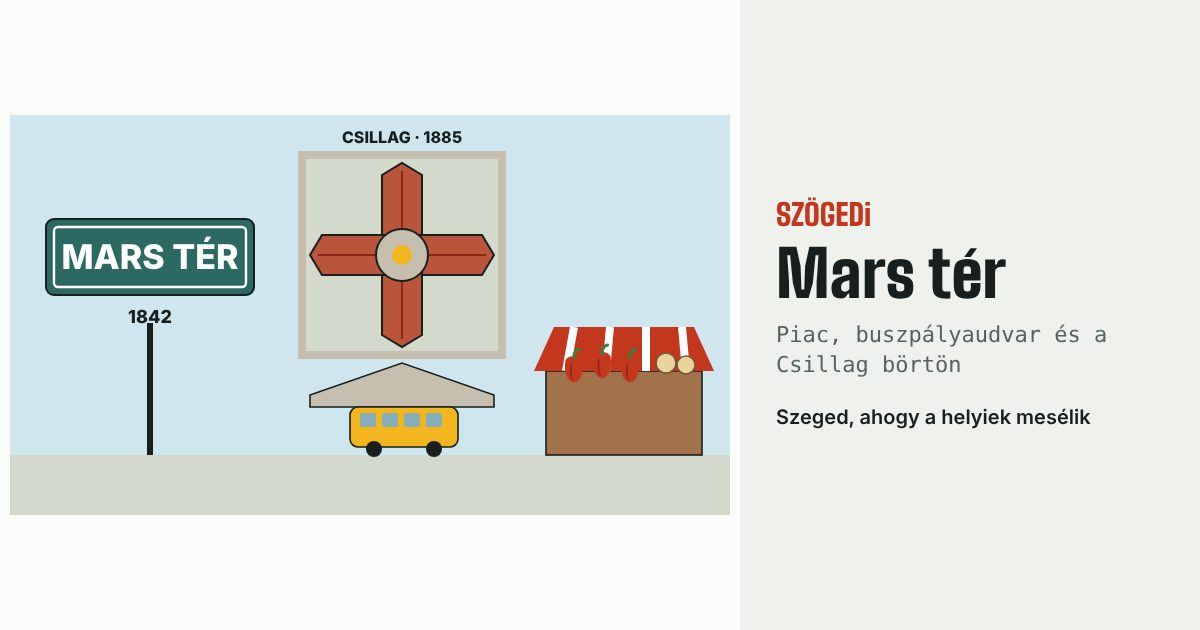
Market, bus station and the Star Prison · named Mars since 1842
It came down to one letter: in 1945 Mars tér became Marx tér. Here are the market, the bus station and the star-shaped prison where Rákosi, Kádár and Szálasi all served time.
The square was laid out in plots in 1731, outside the old town. In 1842 it was named Mars, after the Roman god of war, because it was a military drill ground.
In 1945 they swapped a single letter and it became Marx tér. Today it is Mars tér again. In 1968 a Marx relief by István Kákonyi was unveiled in the gateway of Mars tér 19, for Marx's 150th birthday.
In the 19th century there were cart and livestock fairs here, later a flea market, so people called it the market of the poor. In 1996 a design competition was held, and brick market halls and a park were built to Péter Vesmás's plans.
The bus station opened on 13 November 1965, designed by János Dianóczky. It is a Y-shaped building with inner platforms; back then its closed-circuit TV, rotating displays and light-signal departures were a marvel. It is now locally protected, but for years there has been talk of moving it next to the main railway station.
Next to the square stands the Csillag (Star) prison. Designed by Gyula Wágner, it opened on 1 January 1885. Seen from above it is star-shaped, hence the name. In the 1930s Mátyás Rákosi was held here and worked as the governor's clerk; János Kádár was here under the name János Csermanek, and Ferenc Szálasi too.
In 1891 Mór Jókai visited and praised its heating. From late 1944 the Red Army used it as a prisoner-of-war camp, cramming some 12,000 people into a building meant for a few hundred.
The Sing Sing club next door is in one of the pavilions of the 1970s industrial fairs. Despite its name it isn't a prison: that's the Csillag.
Open in the app →Animated scene, old photos, stamps and the full map. Free, nothing to install.Facts and labels
- True1842: Mars tér. 1945: Marx tér. Today Mars tér again.
- TrueBus station: 13 November 1965, János Dianóczky. Locally protected.
- TrueCsillag prison: 1885, Gyula Wágner. Its inmates included Mátyás Rákosi, János Kádár and Ferenc Szálasi.
- Open questionWhen did it become Mars tér again? We're still looking for the exact year.
People say
Many people believe that Jókai Mór was also once a prisoner in the Csillag prison.
What we know: According to Szeged folyóirat, Jókai came here as a visitor, not as a prisoner.
Where it was said: Bátyi Zoltán: Szegedi bűnhistória, Csillag a Marson (Szeged folyóirat)